


Starting a WPC Manufacturing Business: Production Line Setup, Materials & Common Mistakes to Avoid
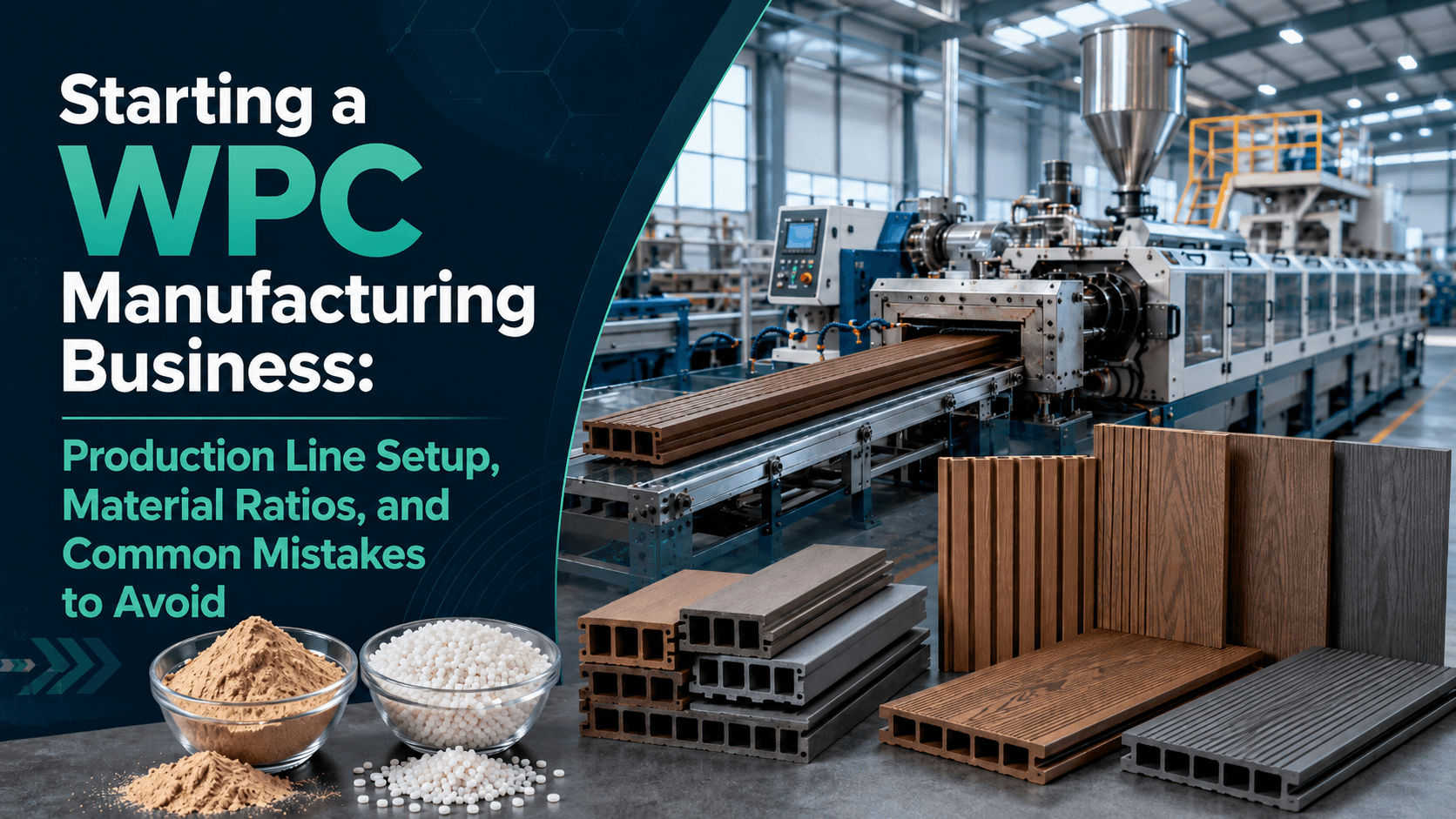
The global demand for wood plastic composite (WPC) products continues to grow as builders, contractors, and material suppliers look for durable, low-maintenance, and moisture-resistant alternatives to natural wood. From outdoor decking and wall cladding to door frames, skirting boards, garden furniture, and decorative profiles, WPC has become a practical material choice for both residential and commercial applications.
For investors planning to enter this market, the key question is not only, “How much does a WPC production line cost?” A more important question is: Do you understand the complete WPC manufacturing process, the right material formulation, and the common production mistakes that can affect product quality?
Starting a WPC manufacturing business requires more than purchasing an extruder. Mixing quality, moisture control, pelletizing stability, die design, extrusion capacity, and formulation testing all determine whether your final profiles can meet customer expectations.
At Hao Yu Precision Machinery, we provide complete wood plastic composite production line solutions for manufacturers worldwide. This guide explains how a WPC production line works, what material ratios are commonly used, how to choose the right WPC extruder model, and which mistakes first-time investors should avoid.
What Is WPC and Why Is the Market Growing?
Wood plastic composite, commonly known as WPC, is a hybrid material made by combining thermoplastic resins with wood flour or wood fiber. Common plastic materials include PVC, PE, PP, and PET, depending on the required product application and market demand.
The result is a composite material that has the appearance of wood but offers improved resistance to water, insects, corrosion, mildew, and dimensional instability. Compared with natural wood, WPC requires less maintenance and does not need painting, sealing, or frequent surface finishing.
WPC products are widely used in:
- Outdoor decking and flooring
- Wall cladding and wall panels
- Skirting boards
- Door frames and window frames
- Fencing
- Garden furniture
- Decorative strips and profiles
- Indoor and outdoor building materials
One of the biggest commercial advantages of WPC is product flexibility. By changing the mold or die head, manufacturers can produce different profile shapes using the same extrusion platform. This makes a WPC extrusion line attractive for companies that want to serve multiple construction and decoration material markets.
WPC is also attractive in regions where environmental compliance and recycled material usage are becoming more important. Many WPC products can be made using recycled plastics and wood waste, giving manufacturers a stronger sustainability story for their customers.
Is WPC Manufacturing a Good Business Opportunity?
A WPC manufacturing business can be a strong opportunity for companies targeting construction materials, outdoor living products, interior decoration materials, or replacement products for natural wood.
However, WPC manufacturing is not a simple plastic extrusion business. The material combines plastic, wood fiber, fillers, stabilizers, lubricants, pigments, and other additives. Each component affects melt flow, surface quality, strength, density, and long-term performance.
Before investing, manufacturers should evaluate:
- Target product type, such as decking, wall panels, or door frames
- Required output capacity
- Local raw material availability
- Wood flour quality and moisture level
- Resin type, such as PVC, PE, PP, or PET
- Factory space and power requirements
- Labor availability
- Die and mold requirements
- Product testing standards
- Target market pricing and competition
The more clearly you define your product range at the beginning, the easier it is to choose the right WPC production line configuration.
Complete WPC Production Line Setup: Stage by Stage
A complete WPC production line generally includes material preparation, mixing, cooling, pelletizing, material handling, and profile extrusion. Each stage affects the next stage, so a weak upstream process can cause serious downstream quality problems.
Hao Yu's WPC production line solutions include equipment for high-speed mixing, cooling and blending, pelletizing, and final WPC profile extrusion.
Stage 1: High-Speed Mixing
The first stage of WPC manufacturing is raw material mixing. Wood flour, plastic resin, stabilizers, lubricants, fillers, colorants, and other additives are loaded into a high-speed mixer.
This stage is critical because the mixer must distribute every component evenly before extrusion. Poor mixing can lead to:
- Uneven color
- Poor surface finish
- Inconsistent profile density
- Weak mechanical strength
- Warping or deformation
- Processing instability during extrusion
A high-speed mixer uses friction-generated heat to help activate and blend the material system. For example, Hao Yu’s HY7-WFG-450 high-speed mixer is designed for preparing WPC compounds before the cooling and pelletizing stages.
For new WPC manufacturers, investing in a reliable mixing system is just as important as choosing the right extruder.
Stage 2: Cooling and Blending
After high-speed mixing, the hot compound must be transferred into a cooling blender. This stage helps reduce material temperature and stabilize the mixed compound before pelletizing.
Hao Yu’s HY7-WPC-300L / 600L vertical cooling blender is used to cool and blend the WPC compound after high-speed mixing.
Cooling is important because excessive heat can damage wood fiber, reduce material stability, and affect final profile quality. If the compound is not cooled properly, manufacturers may experience:
- Surface defects
- Unstable pellet quality
- Poor material feeding
- Inconsistent extrusion performance
- Color variation
Skipping or shortening the cooling stage is one of the most common causes of unstable WPC production.
Stage 3: WPC Pelletizing
After mixing and cooling, the compound is processed through a WPC pelletizer extrusion line to produce uniform WPC pellets.
Pelletizing creates an intermediate raw material that is easier to handle, store, and feed into the final profile extrusion line. Compared with feeding raw materials directly into the profile extruder, using pre-compounded pellets gives manufacturers better control over:
- Material uniformity
- Feeding stability
- Final profile density
- Surface quality
- Production consistency
- Color and additive distribution
Hao Yu's HY7/WPC-P120 pelletizer extrusion line is designed for WPC resin manufacturing and can support production capacity up to 250 kg/hr. Optional accessories include a wood flour dryer, humidity tester, chiller, water cooling tower, movable electronic balance, portable sewing machine, and wood flour grinder.
For manufacturers who want stable commercial production, pelletizing is not just an optional step. It is a key process for improving WPC profile quality and reducing production problems.
Stage 4: WPC Resin Handling and Moisture Control
Once WPC pellets are produced, they must be stored and handled correctly before entering the profile extrusion stage.
Moisture control is especially important in WPC manufacturing because wood flour naturally absorbs water. If pellets or wood flour contain too much moisture, the final WPC profiles may suffer from:
- Surface bubbling
- Internal voids
- Poor surface smoothness
- Reduced strength
- Unstable extrusion
- Higher scrap rate
For consistent production, wood flour should be properly dried before mixing. In many WPC production setups, the wood flour moisture content should be controlled carefully before entering the mixer.
A humidity tester and wood flour dryer can help manufacturers monitor and control this risk before it becomes a quality problem.
Stage 5: WPC Profile Extrusion
The final stage is WPC profile extrusion. The WPC pellets are fed into the extruder, melted, pressurized, and pushed through a shaped die to form the finished profile.
A complete WPC profile extrusion line usually includes:
- Main extruder
- Die head or mold
- Cooling station
- Caterpillar take-off unit
- Cutting device
- Stacker
Hao Yu's WPC Profile Extrusion Line HY7-WP50/70/100/120/150 is designed for producing WPC profiles such as flooring, wall panels, skirting boards, strips, bars, and other building material profiles.
One of the major advantages of a WPC extrusion line is production flexibility. By changing the mold head, manufacturers can produce different profile designs with the same extrusion system. This allows a WPC manufacturer to expand from one product category into multiple product lines as market demand grows.
Common WPC Material Ratios
Material formulation is one of the most important factors in WPC manufacturing. Even with high-quality machinery, a poor formulation can still cause product defects, unstable processing, or weak performance.
The exact formulation depends on the product application, resin type, local raw material quality, and customer requirements. However, a common starting point for a PVC-based WPC formulation may include:
| Component | Typical Range |
|---|---|
| PVC resin | 40–55% |
| Wood flour, usually 80–100 mesh | 30–45% |
| Stabilizer, such as calcium-zinc or lead-based system | 3–5% |
| Internal and external lubricant | 2–4% |
| Calcium carbonate filler | 5–15% |
| Colorant or pigment | 1–3% |
This formulation should be treated as a reference only. Before mass production, manufacturers should test and adjust the ratio based on the actual product, raw material source, and performance requirements.
How Material Ratios Affect WPC Product Quality
A WPC formula must balance cost, appearance, strength, processability, and long-term performance.
Higher Wood Flour Content
Increasing wood flour content can reduce material cost and improve the natural wood-like appearance of the profile. However, too much wood flour can reduce impact strength, increase moisture sensitivity, and make the material more difficult to process.
Higher wood content may also increase the risk of surface defects if moisture is not controlled properly.
Higher Plastic Resin Content
Increasing the plastic resin ratio can improve melt flow, structural strength, weathering performance, and moisture resistance. However, it also increases material cost and may change the density or appearance of the final product.
Stabilizer Selection
Stabilizers are especially important in PVC-based WPC production. They help protect the material during processing and improve long-term performance.
Calcium-zinc stabilizer systems are increasingly preferred in export markets where customers require lead-free or RoHS-compliant materials. For manufacturers targeting Europe, North America, or higher-end construction markets, stabilizer selection should be considered early in the formulation stage.
Lubricant Balance
Lubricants help control melt flow, reduce friction, improve surface quality, and support stable extrusion. Too little lubricant can cause high processing resistance and poor surface finish. Too much lubricant can reduce bonding strength and cause unstable extrusion.
A good WPC formulation requires testing, not guesswork.
Choosing the Right WPC Extruder Model
The right WPC extruder depends on your target production scale, product size, required output, and future expansion plan.
| Model | Output Range | Best For |
|---|---|---|
| HY7-WP70 | 30–65 kg/hr | Entry-level production, product trials, pilot runs |
| HY7-WP100 | 70–100 kg/hr | Small to mid-scale commercial production |
| HY7-WP120 | 90–140 kg/hr | Mid-scale production with product flexibility |
| HY7-WP150 | 130–200 kg/hr | High-volume commercial production |
Choosing the smallest machine only to reduce initial cost can limit your production capacity later. If the extruder is operated at maximum output continuously, it may increase wear, reduce process stability, and make it harder to scale when orders increase.
For investors planning a three-to-five-year production roadmap, right-sizing the extruder from the beginning is usually more economical than replacing an undersized machine too soon.
Common Mistakes New WPC Manufacturers Should Avoid
Many first-time WPC manufacturers focus too much on the final extruder and underestimate the importance of preparation, formulation, and process control. The following mistakes are common during the first year of operation.
Mistake 1: Underestimating Mixing Quality
Mixing quality directly affects final product quality. If the wood flour, resin, additives, and pigments are not evenly mixed, the extruder cannot fully correct the problem later.
Poor mixing may cause:
- Color streaks
- Surface roughness
- Weak bonding
- Inconsistent density
- Profile warping
- Higher scrap rate
A reliable high-speed mixer and cooling blender are essential for stable WPC production.
Mistake 2: Using Wet Wood Flour
Wood flour moisture is one of the most common causes of WPC production failure.
If the wood flour is too wet, moisture turns into vapor during extrusion and creates bubbles or voids inside the profile. These defects may not only affect appearance but also reduce structural strength.
To avoid this problem, manufacturers should:
- Dry wood flour before mixing
- Store wood flour in a dry environment
- Use a humidity tester
- Monitor moisture content regularly
- Avoid using raw materials exposed to humid conditions
A wood flour dryer and humidity tester are highly recommended for stable production.
Mistake 3: Choosing Extruder Capacity Based Only on Budget
It is tempting to choose a smaller extruder to reduce initial investment, but this can become expensive later.
If production demand increases, an undersized extruder may create bottlenecks. Running a small machine at full capacity for long periods can also increase wear and reduce production stability.
Instead of choosing by price alone, manufacturers should consider:
- Monthly sales target
- Number of product types
- Profile size and weight
- Required output per shift
- Future expansion plan
- Local labor and operating cost
A properly sized WPC extruder helps improve production efficiency and long-term return on investment.
Mistake 4: Ignoring Die Head and Mold Maintenance
The die head determines the final profile shape, dimension, and surface quality. If carbonized material builds up inside the die, the profile surface may gradually develop defects.
Common signs of poor die maintenance include:
- Lines on the profile surface
- Uneven thickness
- Flow marks
- Rough edges
- Poor dimensional accuracy
- Increased scrap rate
Manufacturers should establish a regular die cleaning and inspection schedule from the beginning. Preventive maintenance is much easier and cheaper than solving quality complaints after shipment.
Mistake 5: Skipping Formulation Testing Before Mass Production
A formulation that works with one wood flour source or PVC grade may not work with another. Raw materials can vary by region, supplier, particle size, moisture level, and chemical composition.
Launching mass production without testing may lead to:
- Material waste
- Unstable extrusion
- Weak product performance
- High rejection rate
- Customer complaints
- Delayed delivery
Before full commercial production, manufacturers should reserve time for formulation testing, trial production, and profile performance evaluation.
Even a two-to-four-week testing period can significantly reduce long-term production risk.
Mistake 6: Treating WPC as Standard Plastic Extrusion
WPC is not the same as conventional plastic extrusion. The addition of wood flour changes the material behavior significantly.
Compared with standard plastic profiles, WPC production requires more attention to:
- Raw material drying
- Additive balance
- Screw design
- Mixing quality
- Melt temperature
- Die flow
- Cooling stability
- Surface treatment
- Cutting accuracy
Investors who treat WPC as a simple plastic extrusion process often experience avoidable quality problems.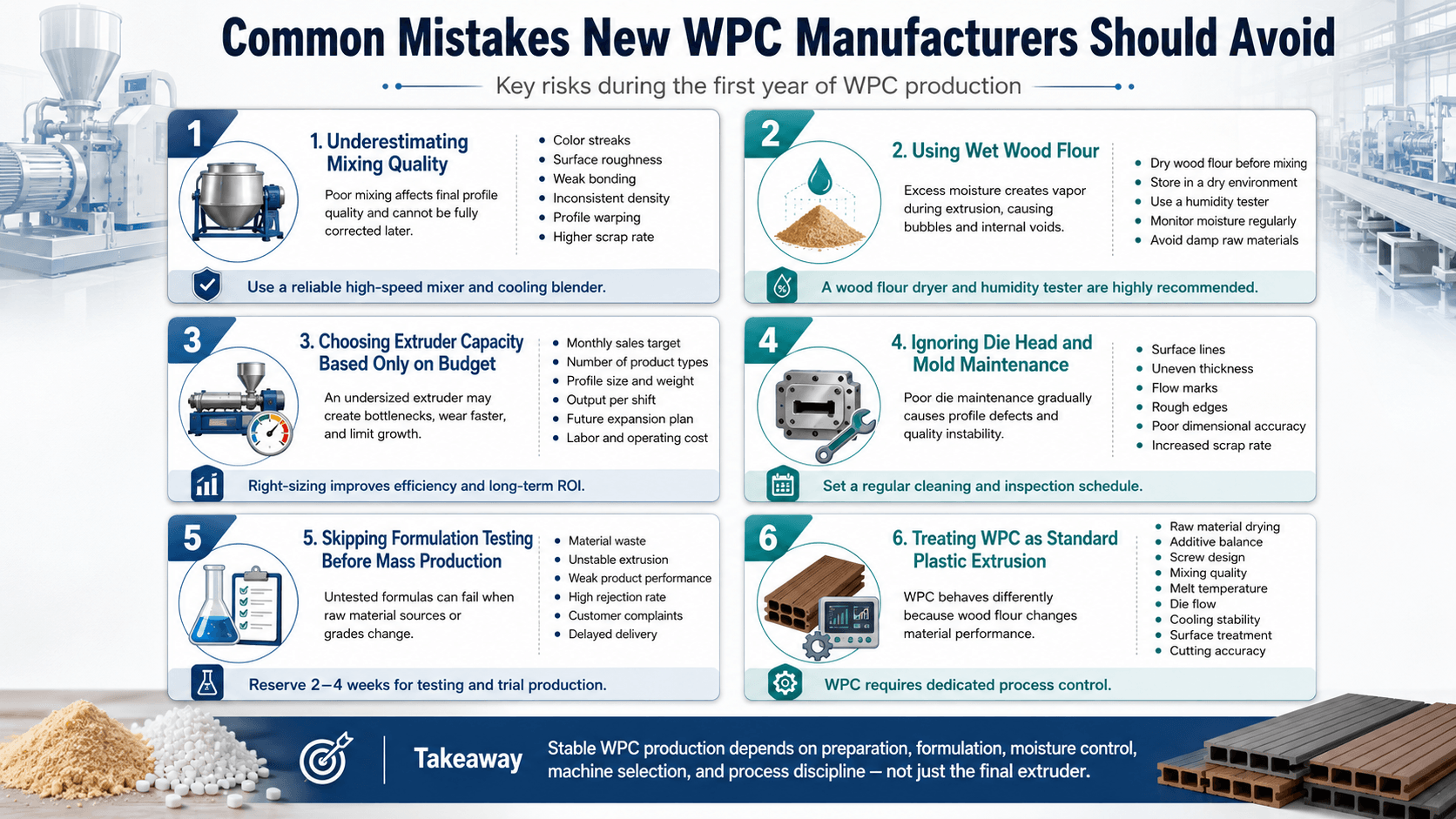
How to Plan a WPC Manufacturing Business
Before purchasing equipment, manufacturers should prepare a basic business and production plan.
Important planning questions include:
- What products do you want to manufacture first?
- Are you targeting indoor or outdoor applications?
- What resin system will you use: PVC, PE, PP, or PET?
- What profile sizes and shapes are required?
- What production output do you need per hour or per month?
- What raw materials are available locally?
- Do you need wood flour drying and grinding equipment?
- How much factory space is available?
- Will you start with one product or multiple profiles?
- Do your customers require lead-free, RoHS, or other compliance standards?
Answering these questions early helps determine the right WPC production line configuration and prevents unnecessary investment mistakes.
Work with Hao Yu to Build the Right WPC Production Line
Starting a WPC manufacturing business can be profitable, but success depends on choosing the right production line and controlling the process from raw material preparation to finished profile output.
At Hao Yu Precision Machinery, we help customers evaluate their product requirements, production scale, raw material conditions, and target market before recommending the right WPC line configuration.
Our WPC production solutions can include:
- High-speed mixer
- Cooling blender
- Wood flour dryer
- Humidity tester
- Pelletizer extrusion line
- WPC profile extrusion line
- Mold and die design
- Cooling station
- Take-off unit
- Cutting device
- Stacker
- Complete line planning support
Whether you are planning to produce WPC decking, wall panels, skirting boards, door frames, outdoor furniture profiles, or customized building materials, Hao Yu can help you configure a production line that fits your manufacturing goals.
Need Help Starting Your WPC Manufacturing Business?
If you are planning to invest in a WPC production line but are not sure which machine model, material ratio, or production setup is right for your market, contact Hao Yu Precision Machinery.
Our engineering team can help you review your product plan, output target, factory space, raw material conditions, and budget, so you can start your WPC manufacturing business with a reliable production foundation.
