

Cement Bag vs. FIBC Jumbo Bag vs. General Woven Sack: Which Production Line Do You Actually Need?
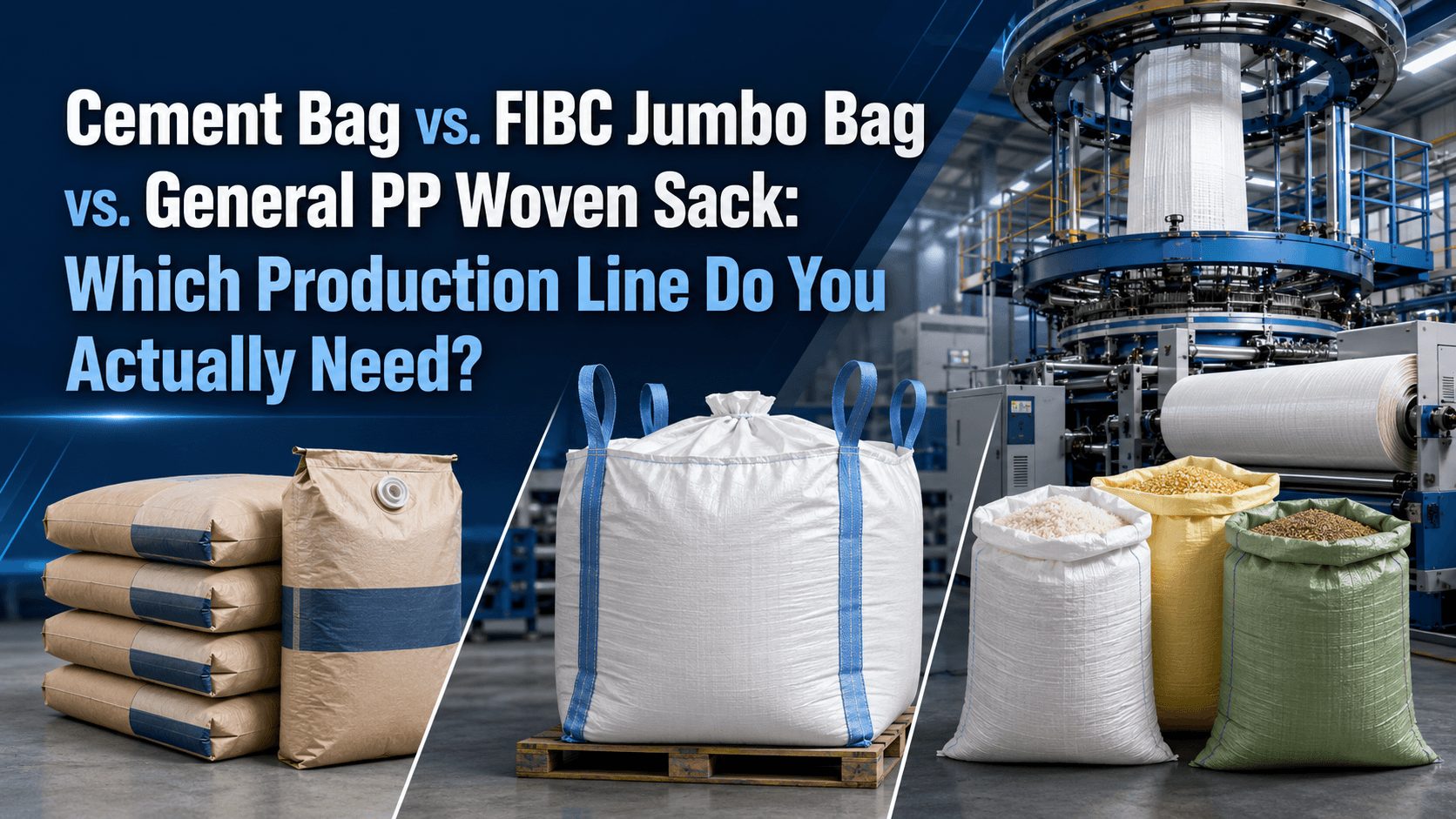
Investing in a PP woven bag production line is not just about buying a circular loom or a bag sewing machine. For manufacturers entering the woven packaging industry, one of the most important decisions is choosing the right line configuration from the beginning.
Cement bags, FIBC jumbo bags, and general PP woven sacks may look similar at first glance. They are all commonly made from polypropylene flat yarn and woven into tubular fabric. However, the required machinery, loom specifications, fabric width, downstream converting process, production complexity, and investment level are significantly different.
Choosing the wrong configuration can lead to unnecessary capital spending, limited production flexibility, or worse, a production line that cannot meet your customers’ bag specifications.
At Hao Yu Precision Machinery, we provide complete PP/PE woven bag machinery and whole-plant equipment for global manufacturers. Our woven bag production solutions have been supplied to customers in markets such as India, Egypt, Mexico, Bangladesh, and many other regions. This guide explains the key differences between general PP woven sack lines, cement bag production lines, and FIBC jumbo bag production lines, helping you determine which system best fits your business goals.
What Do These Three Bag Production Lines Have in Common?
Although the finished bags serve different markets, the upstream production process is similar. Most PP woven bag production lines begin with three core stages:
1. Raw Material Mixing
PP or HDPE pellets are blended with additives in a thermal mixer to ensure consistent material quality before extrusion. A stable mixing process helps improve yarn strength, melt consistency, and overall production reliability.
For example, Hao Yu's HY7-350 mixer is designed with a 300 kg tank capacity, making it suitable for preparing raw materials for woven bag production.
2. Flat Yarn Extrusion
The mixed material is fed into a PP/HDPE flat yarn extrusion line, where it is melted, extruded, slit, stretched, and wound into flat yarn. This yarn becomes the base material for circular weaving.
Hao Yu's HY7/SP-100HE flat yarn extrusion line can deliver up to 240 kg/hr output. Features such as a belt-type screen filter changer and rotary blade slitting system help reduce downtime and support stable yarn production.
3. Circular Weaving
The flat yarn is then woven into tubular fabric using a circular loom. This is where the production line begins to differ depending on the final bag type.
For general PP woven sacks and cement bags, a 6-shuttle circular loom is commonly used. For FIBC jumbo bags, however, a wider 8-shuttle circular loom is required due to the larger fabric width and higher strength requirements.
General PP Woven Sack Production Line: The Flexible Foundation
A general PP woven sack production line is the most versatile option for manufacturers who need to produce standard woven bags for agriculture, construction materials, chemicals, and general industrial packaging.
These bags are commonly used for:
- Rice
- Flour
- Sugar
- Fertilizer
- Animal feed
- Sand
- Gravel
- Powder
- Chemical products
- General export packaging
This type of production line is often the best starting point for new investors because it offers a broad customer base and relatively flexible bag size options.
Key Machine: 6-Shuttle Circular Loom
For standard PP woven sacks, the key weaving equipment is typically a 6-shuttle circular loom. Hao Yu's HY7-m6SCL mini six-shuttle circular loom runs at up to 183 RPM and can achieve fabric output of up to 135 meters per hour.
The machine is equipped with features such as:
- Auto-stop system for broken warp yarn
- Auto-stop system for broken weft yarn
- Automatic weaving compensation system
- Stable fabric density control
- Reduced empty weaving
- Consistent tubular fabric output
These features help manufacturers improve production efficiency while maintaining stable woven fabric quality.
Downstream Process: Auto Cutting and Sewing
After circular weaving, the tubular fabric is processed by a high-speed auto cutting and sewing machine. Hao Yu's HY7/SP-150H high-speed auto cutting and sewing machine converts tubular cloth rolls into finished bottom-fold sewn bags.
This automated process includes:
- Tubular fabric unwinding
- Bag length cutting
- Bottom folding
- Sewing
- Counting
- Stacking
Compared with manual production, an automatic cutting and sewing line helps reduce labor dependency and improve bag consistency.
Optional Printing: One-Side Four-Color Printing
For customers that require branding, product information, or export packaging designs, a one-side four-color printing machine can be added to the line.
Hao Yu’s HY7-104 printing machine can run up to 50 pieces per minute and supports individual ink circulation for each color station, making it suitable for general woven sack branding.
Best For
A general PP woven sack production line is best for:
- Agricultural cooperatives
- Grain and flour packagers
- Fertilizer producers
- Construction material suppliers
- Chemical packaging companies
- General commodity exporters
- Manufacturers producing 5 kg to 50 kg bags
Key Advantage
The biggest advantage of a general woven sack line is flexibility. It allows manufacturers to serve multiple industries with one production system, making it a practical entry-level to mid-level investment.
Cement Bag Production Line: Precision Forming for Construction Packaging
A cement bag production line has more demanding requirements than a general PP woven sack line. Cement bags must provide good sealing, moisture resistance, dust control, and stable stacking performance.
In many cases, cement bags are produced as valve-type bags or block-bottom valve bags. These structures cannot be produced using only a standard woven sack cutting and sewing process.
To manufacture cement bags properly, the line usually requires additional lamination and dedicated bag forming equipment.
Why Cement Bags Need Lamination
Cement, dry-mix mortar, gypsum, and lime are sensitive to moisture and dust leakage. A standard unlaminated woven sack may not provide enough protection for these materials.
That is why cement bag production typically requires an outside lamination process. Hao Yu’s extrusion coating lamination machine applies a PE or PP film layer onto the woven substrate, improving:
- Moisture resistance
- Bag strength
- Surface smoothness
- Printability
- Dust leakage control
- Stacking performance
This lamination process is especially important for bags stored in humid warehouses or outdoor job sites.
Cement Bag Forming and Conversion
After lamination, the woven fabric roll enters a dedicated cement bag forming machine or block bottom laminated valve bag conversion line.
A complete cement bag converting process may include:
- Unwinding
- Roll-to-roll flexographic printing
- Ultrasonic cutting
- Preforming
- Pasting or forming
- Valve forming
- Bottom forming
- Cutting
- Counting
- Finished cement bag output
This equipment transforms laminated woven fabric into finished cement bags with accurate valve and bottom structures.
Key Difference from a General Woven Sack Line
A standard PP woven sack line mainly requires circular weaving, cutting, sewing, and optional printing. A cement bag line requires additional machinery, including:
- Outside lamination machine
- Roll-to-roll printing machine
- Ultrasonic cutting machine
- Block bottom laminated valve bag conversion line
Because of these extra stages, the investment level, production space, and technical requirements are higher than a general woven sack line.
Best For
A cement bag production line is best for:
- Cement manufacturers
- Dry-mix mortar producers
- Gypsum packagers
- Lime packagers
- Construction material packaging suppliers
- Companies supplying valve bags to the building materials industry
Key Advantage
The main advantage of a cement bag production line is the ability to produce higher-value packaging for demanding construction applications. For companies targeting cement or dry-mix customers, lamination and valve bag forming equipment are not optional — they are essential.
FIBC Jumbo Bag Production Line: Wider Fabric and Higher Load Capacity
A FIBC jumbo bag production line is designed for producing large bulk bags, also known as flexible intermediate bulk containers, big bags, or jumbo bags.
Unlike standard woven sacks, FIBC bags are engineered to carry heavy loads, usually from 500 kg to 2,000 kg per bag. Because of this, the production line requires wider fabric, stronger weaving density, reinforced lifting loops, and more complex sewing processes.
Key Machine: 8-Shuttle Circular Loom
The biggest difference between a standard woven sack line and a jumbo bag production line is the circular loom specification.
General PP woven sacks are usually produced with a 6-shuttle loom. FIBC jumbo bags require much wider tubular fabric, typically in the range of 145 to 195 cm. For this reason, an 8-shuttle circular loom is required.
Hao Yu's HY7-m8SCL 8-shuttle circular loom is designed for weaving wide tubular fabric for jumbo bags and tarpaulin applications. It supports a working width of 145 to 195 cm and is suitable for FIBC fabric production.
The machine can run at up to 80 RPM with 2,000 warp ends and a weaving density of 8 to 14 picks per inch, supporting the fabric strength needed for heavy-duty bulk handling.
Downstream Process for FIBC Jumbo Bags
The downstream process for FIBC jumbo bags is more complex than standard woven sack production. A complete jumbo bag production line may include:
- Jumbo bag making machine
- Flexographic jumbo bag printing machine
- Belt knitting machine
- Sewing machine
- Treatment or testing station
Each of these stages plays an important role in producing safe and reliable bulk bags.
Belt Knitting and Loop Sewing
One of the most important differences in FIBC production is the lifting loop system. Jumbo bags must be lifted by forklifts, cranes, or handling systems, so the loops must meet strict strength and safety requirements.
A belt knitting machine is used to produce lifting belts or loops. These loops are then sewn onto the bag body using specialized sewing equipment.
The sewing process may include:
- Body panel sewing
- Loop attachment
- Top spout sewing
- Bottom discharge spout sewing
- Liner pocket sewing
- Reinforcement sewing
Compared with standard woven sacks, jumbo bag assembly involves more manual or semi-automatic sewing steps, and each bag takes longer to produce.
Testing and Safety Requirements
Because FIBC bags are used for heavy-duty bulk handling, finished bags may need to undergo load testing or quality inspection before shipment. This helps ensure that the bags meet the required safe working load standards for the intended application.
Key Difference from a General Woven Sack Line
A FIBC jumbo bag line requires:
- 8-shuttle wide circular loom
- Wider fabric production capability
- Jumbo bag making machine
- Belt knitting machine
- Specialized sewing stations
- Treatment or testing equipment
The production line is longer, more labor-intensive, and more technically demanding than a standard woven sack line.
Best For
A FIBC jumbo bag production line is best for:
- Chemical companies
- Petrochemical companies
- Mining operations
- Food ingredient exporters
- Plastic resin producers
- Fertilizer manufacturers
- Logistics companies
- Bulk dry goods suppliers
Key Advantage
The main advantage of a jumbo bag production line is access to the industrial bulk packaging market. Although the production process is more complex, FIBC bags usually serve higher-value applications and long-distance supply chains.
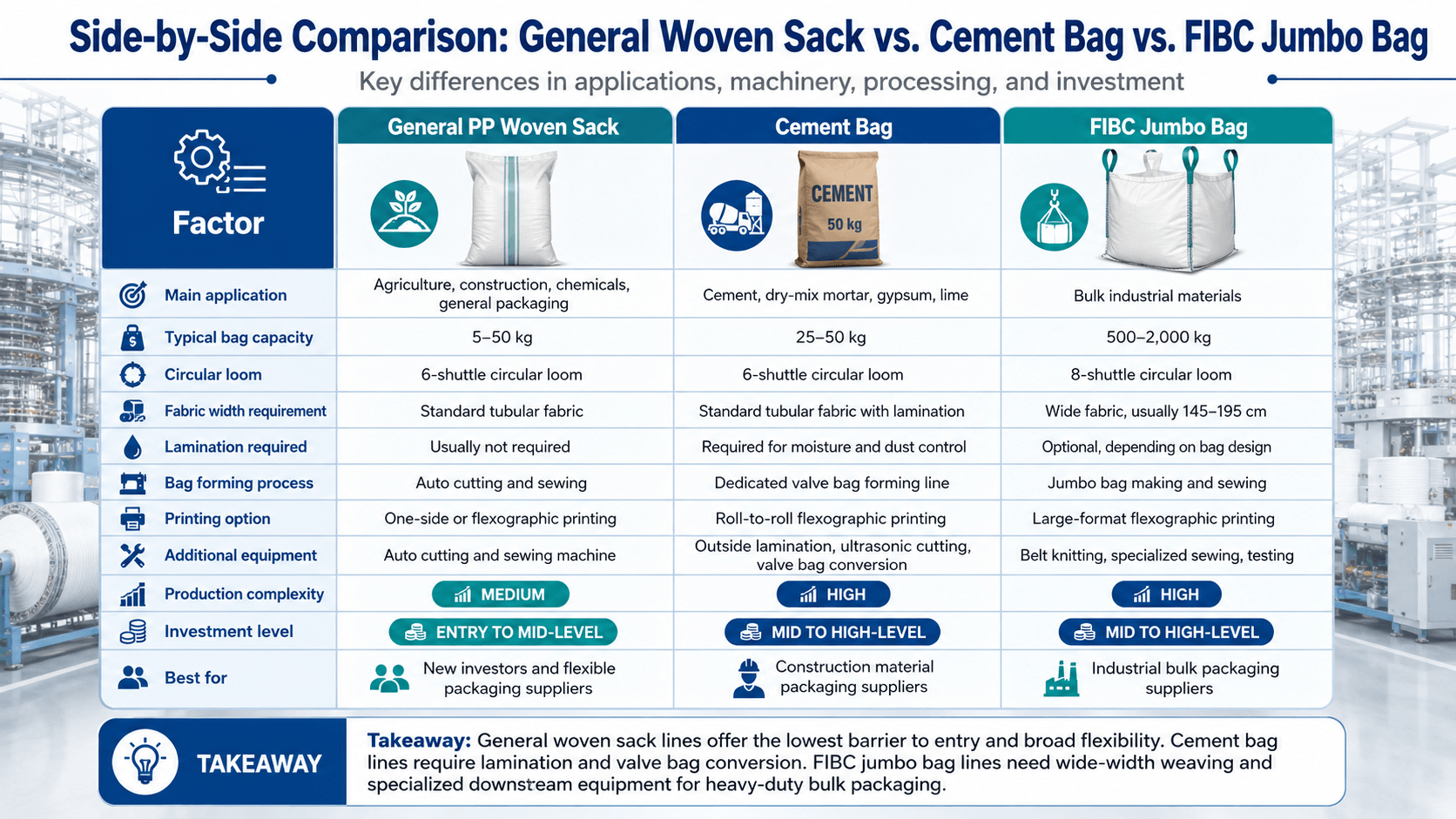
Side-by-Side Comparison: General Woven Sack vs. Cement Bag vs. FIBC Jumbo Bag
| Factor | General PP Woven Sack | Cement Bag | FIBC Jumbo Bag |
|---|---|---|---|
| Main application | Agriculture, construction, chemicals, general packaging | Cement, dry-mix mortar, gypsum, lime | Bulk industrial materials |
| Typical bag capacity | 5–50 kg | 25–50 kg | 500–2,000 kg |
| Circular loom | 6-shuttle circular loom | 6-shuttle circular loom | 8-shuttle circular loom |
| Fabric width requirement | Standard tubular fabric | Standard tubular fabric with lamination | Wide fabric, usually 145–195 cm |
| Lamination required | Usually not required | Required for moisture and dust control | Optional, depending on bag design |
| Bag forming process | Auto cutting and sewing | Dedicated valve bag forming line | Jumbo bag making and sewing |
| Printing option | One-side or flexographic printing | Roll-to-roll flexographic printing | Large-format flexographic printing |
| Additional equipment | Auto cutting and sewing machine | Outside lamination, ultrasonic cutting, valve bag conversion | Belt knitting, specialized sewing, testing |
| Production complexity | Medium | High | High |
| Investment level | Entry to mid-level | Mid to high-level | Mid to high-level |
| Best for | New investors and flexible packaging suppliers | Construction material packaging suppliers | Industrial bulk packaging suppliers |
How to Choose the Right PP Woven Bag Production Line
Choosing the right production line depends on your target market, required bag specifications, production capacity, and investment budget.
Choose a General PP Woven Sack Line If:
You want to serve a broad range of customers and produce standard packaging bags for agriculture, construction, chemical, or commodity markets.
This is often the most practical option for new investors because it provides:
- Lower entry barrier
- Flexible bag size range
- Broad customer applications
- Lower production complexity
- Easier operation and maintenance
If your customers need 5 kg to 50 kg woven sacks, a general PP woven sack line is usually the best starting point.
Choose a Cement Bag Line If:
Your target customers are cement plants, dry-mix mortar producers, gypsum suppliers, or construction material brands.
In this market, bag sealing, moisture resistance, dust control, and stacking quality are critical. A standard woven sack line is not enough.
You will need:
- 6-shuttle circular loom
- Outside lamination machine
- Roll-to-roll printing machine
- Ultrasonic cutting machine
- Block bottom laminated valve bag conversion line
If cement packaging is your target market, investing in the correct lamination and valve bag forming equipment from the beginning is essential.
Choose a FIBC Jumbo Bag Line If:
You want to produce bulk bags for heavy-duty industrial packaging.
FIBC jumbo bags require wide woven fabric, strong lifting loops, reinforced sewing, and quality testing. A standard 6-shuttle circular loom cannot produce the required wide fabric for jumbo bag bodies.
You will need:
- 8-shuttle circular loom
- Jumbo bag making machine
- Flexographic jumbo bag printing machine
- Belt knitting machine
- Specialized sewing machine
- Treatment or testing station
If your market involves bulk handling, mining, chemicals, plastic resin, fertilizer, or food ingredients, an FIBC jumbo bag production line is the right configuration.
The Most Common Mistake: Trying to Use One Line for Every Bag Type
One of the most common mistakes new investors make is assuming that a general PP woven sack line can easily be adapted later for cement bags or jumbo bags.
In reality, each production line has different core equipment.
A general woven sack line is built around flexible standard bag production. A cement bag line requires lamination and valve bag conversion. A FIBC jumbo bag line requires a wide 8-shuttle loom and specialized sewing equipment.
Trying to modify the wrong line later may result in:
- Additional equipment costs
- Production bottlenecks
- Limited bag specifications
- Lower product quality
- More manual labor
- Difficulty meeting customer requirements
- Delayed return on investment
Planning the correct production line from the beginning can save both capital and time.
Work with Hao Yu to Build the Right Woven Bag Production Line
Every woven bag manufacturer has different requirements. Some need a compact starter line for standard PP woven sacks. Others need a complete cement bag production system with lamination and valve bag forming. Some customers require a full FIBC jumbo bag production line for bulk packaging applications.
At Hao Yu Precision Machinery, our engineering team helps customers evaluate:
- Final bag type
- Bag size and capacity
- Fabric width
- Required output
- Printing requirements
- Lamination requirements
- Available factory space
- Labor conditions
- Budget planning
- Future expansion needs
We provide complete production line solutions from raw material mixing, flat yarn extrusion, circular weaving, printing, lamination, cutting, sewing, forming, and final bag output.
Whether you need a general PP woven sack production line, a cement bag making machine line, or a complete FIBC jumbo bag production line, Hao Yu can help you configure the right system for your market.
Need Help Choosing the Right Production Line?
If you are planning to invest in PP woven bag machinery but are not sure which line configuration fits your product, contact Hao Yu Precision Machinery.
Our team can help you compare machine options, production capacity, factory layout, and investment requirements, so you can choose the right woven bag production line from day one.
